
Tribute-(aries)
Making my way from point A to point B(e)

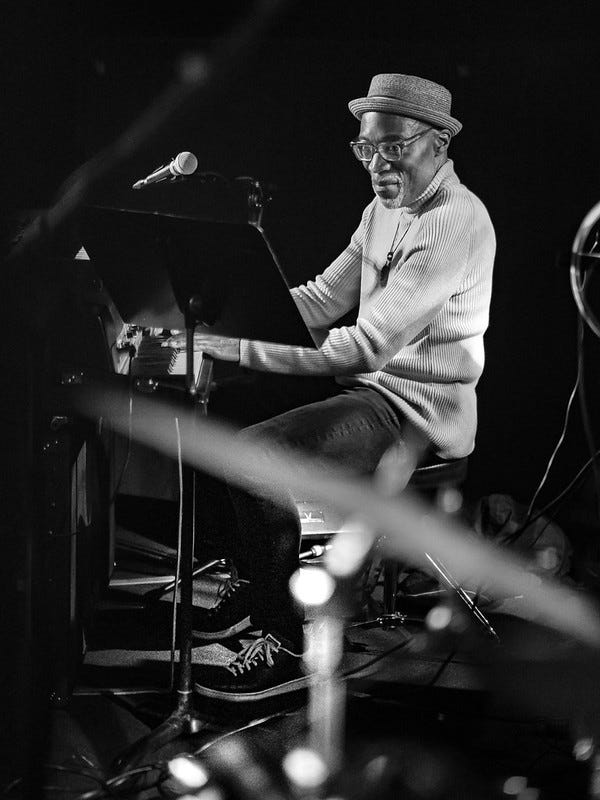
Last weekend I had the most fun I’ve had playing music in a while. My trio DG3 performed the music of Stevie Wonder for a full house of avid jazz lovers at an event presented by Portland’s jazz radio station KMHD. In keeping with their trademark “Jazz Without Boundaries,” we stretched those classics every which way. Reflecting on that performance got me thinking about tributes, tradition, and finding oneself.
I’m reading Rick Rubin’s fascinating book The Creative Act: A Way of Being. In it, he talks about not trying to fit in. “If anything,” he says, the goal is to “amplify the differences, what doesn’t fit, the special characteristics unique to how you see the world.”
The music and culture of jazz definitely embodies this idea. At the same time, it prescribes respect, often bordering on reverence, for “the tradition.”
The mid-1980s, when I came of age as a professional jazz musician, was a period of incredible resurgence for the music, marked by an explosion of youth energy, technological innovation — computers, CDs, digital audio — and a healthy dose of cultural conservatism. For me, this meant grappling with my relationship to what was described as the “jazz tradition,” even as I tried to leverage that tradition to blaze my own creative pathways.
My first solution was to accept the invitation to join the band of jazz icon Betty Carter, and at the same time release an eclectic jazz/funk/fusion album with my own group Current Events on the new Verve Records imprint Verve/Forecast. It seemed like a culmination of all that I had been working for up to that point, even to the point of stepping away from Betty’s gig — “it was time,” she said — to pursue my own path as a leader. It felt that way right up to the point when we were dropped from the label shortly after releasing what I had assumed was a noteworthy debut.
I have to smile in hindsight at the youthful naivety with which my bandmates and I walked into the label’s A&R offices, on the heels of our rise to #15 on the Billboard Contemporary Jazz charts, to inform them of our intention to self-produce our follow-up record. Their response, predictably, was “thanks, but no thanks.”
While not exactly a blessing in disguise, that rejection led to some much-needed humility with regard to my career trajectory, and the desire to actually understand the music business. I started reading business books and spent a couple of years drafting a business plan for my own production company, Sojourn Productions — yes, after the Patrice Rushen song—and trying to emulate my hero Quincy Jones in dipping my toes in all musical streams..
Although I never enacted the plan, it became a useful roadmap for the next steps in my career, including deciding that if the world wasn’t ready for me as a performer to offer the eclectic mashup of styles and genres that the young Darrell had dreamed of, then I would go ahead and be the “young lion” that this era seemed to be inviting me to be.
In what felt calculated at the time, but in retrospect seems more like intuition, I set the intention, walking from the subway to my Brooklyn flat one night, to write an album that could make the top 10 Jazz list in The New York Times, and then started humming what would become the title track on my debut record under my own name.
Black Art did wind up earning that accolade, which seemed to confirm my choice to focus on “straight-ahead” jazz. Fortuitous associations with Tony Williams, Frank Morgan, Roy Haynes, and my fellow “young lions” Wallace Roney, Christian McBride, and Brian Blade certainly didn’t hurt.
As exciting and gratifying as that period was, I’m thankful that the ensuing years have brought more clarity around there being a “right” way to go about something — whether managing a career or being true to a musical tradition. Moving from New York to Portland in the late ‘90s also encouraged both re-invention and re-discovery.
In 2013 PDX Jazz asked me to put together a tribute to the Modern Jazz Quartet. I was not a particular fan of tribute projects at that time, wanting instead to prioritize my own voice as a composer. But I’m glad I allowed myself to be persuaded. That performance introduced me to a repertoire I had previously overlooked, opened the door to revisiting the chamber music I fell in love with in my conservatory days, and introduced me to the elegantly restrained pianism of John Lewis, which impacted my own approach to the instrument. It also became the seed for MJ New—my now 13-year-old chamber jazz quartet.
A few years later I received another invitation from the jazz festival. This time to create a performance exploring the music of Sting. They didn’t have to ask me twice for that one. The music of Sting and The Police was a major part of the soundtrack of my 20s and 30s. That show, called Sting: The Jazz Remix yielded twelve original arrangements (an album’s worth for any producers out there looking for a studio-ready project), and gave me a welcome chance to follow that Quincy-inspired impulse to move freely between jazz and pop music.
I’ve come a long way from my “young lion” days. However, I still keep handwritten reminders taped to the wall of my teaching studio that say “there is no one right way,” and “my way is the right way for me.”
So, back to last weekend. Other than whittling down my list of must-play Stevie Wonder tunes from sixty-five to five, bringing my full self to that endeavor felt natural and easy.
In fact, most of the time now, it feels good to make the choice to lean into being me —even when celebrating one of the giants of 20th-century music. As I approach my 64th birthday, I’m happy to discover new tributaries that feel both like the right amount of not giving a f**k, and a proper next step in what is turning out to be a lifelong process of growing up.
DG
Hello Darrell! What were the Stevie Wonder tunes you worked up for the KMHD show? Did the station tape the show? Be nice to turn on the radio and hear it. One of the bands I'm in play's "I Wish" sometime - it's the "Banana Band" that plays demonstrations, counterdemonstrations,. community events and sometime actions in front of the ICE house in So. Portland. We really get the resistance dancing!